Abstract
Wearable motion capture and humanoid robots both measure motion with IMUs, yet the two embodiments differ in morphology, sensor placement, and sampling rate, and kinematically generated humanoid data lack the contact dynamics and sensor imperfections of hardware. We present one inertial representation that bridges both gaps: a shared interface of twelve anatomically corresponding sites, a continuous-time encoder for arbitrary sampling rates, and a Transformer trained jointly on real human motion and IK-retargeted Unitree G1 motion with velocity, trajectory, denoising, and language objectives. Deployed on a physical G1 without dynamics simulation, real-robot training data, or fine-tuning, a single checkpoint achieves the lowest velocity error among the evaluated methods on three human datasets, retargeted G1 motion, and real-G1 recordings, and transfers language-grounded motion semantics from humans to the robot.
Video
Zero-shot on a Real Unitree G1
Trained on no real-robot trajectory, the model estimates the pelvis path on hardware from inertial measurements alone. Left: the recording. Right: our estimate, with the robot posed from the measured joints along the predicted trajectory (gold).
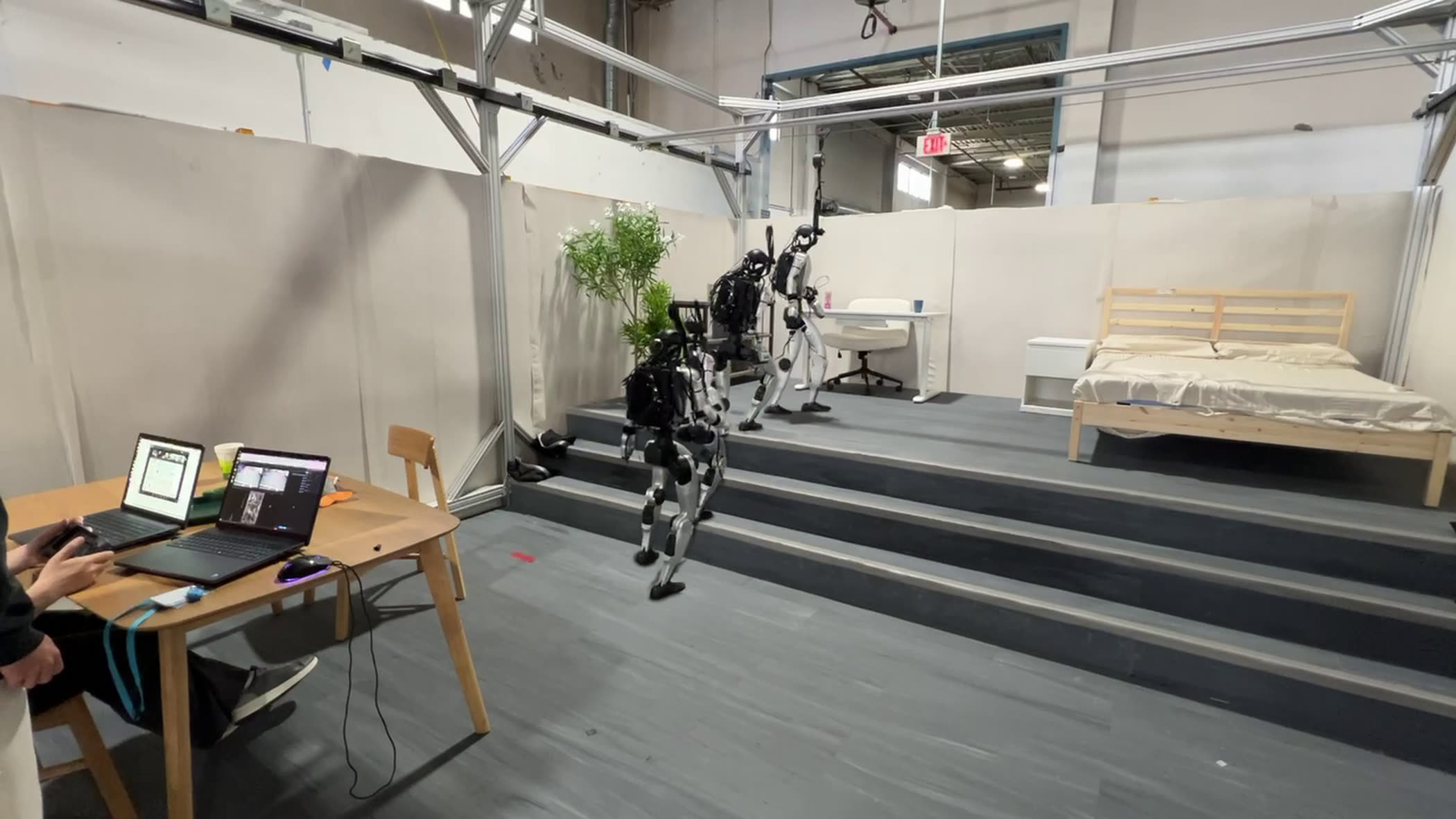
Recording · climbing
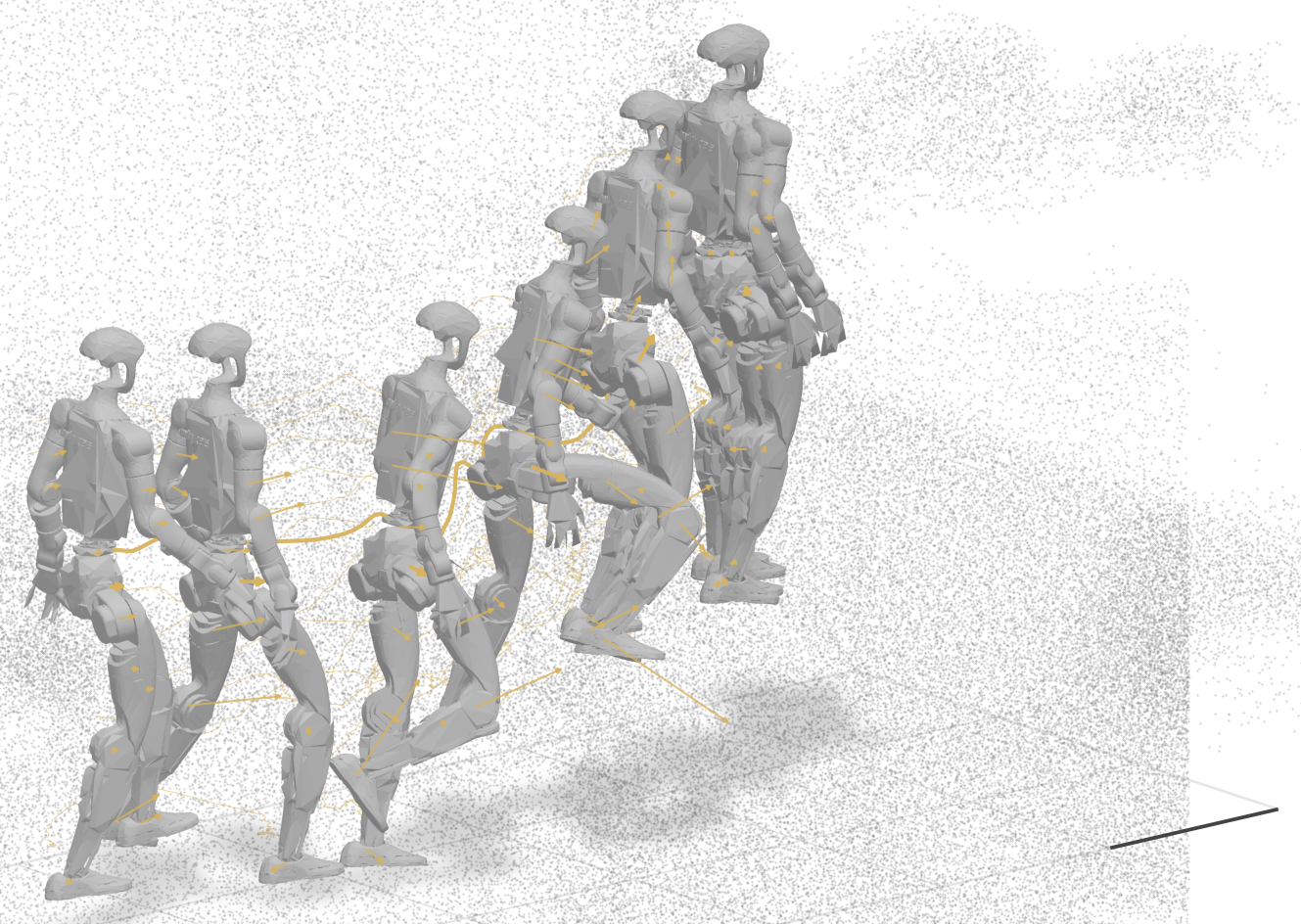
Ours
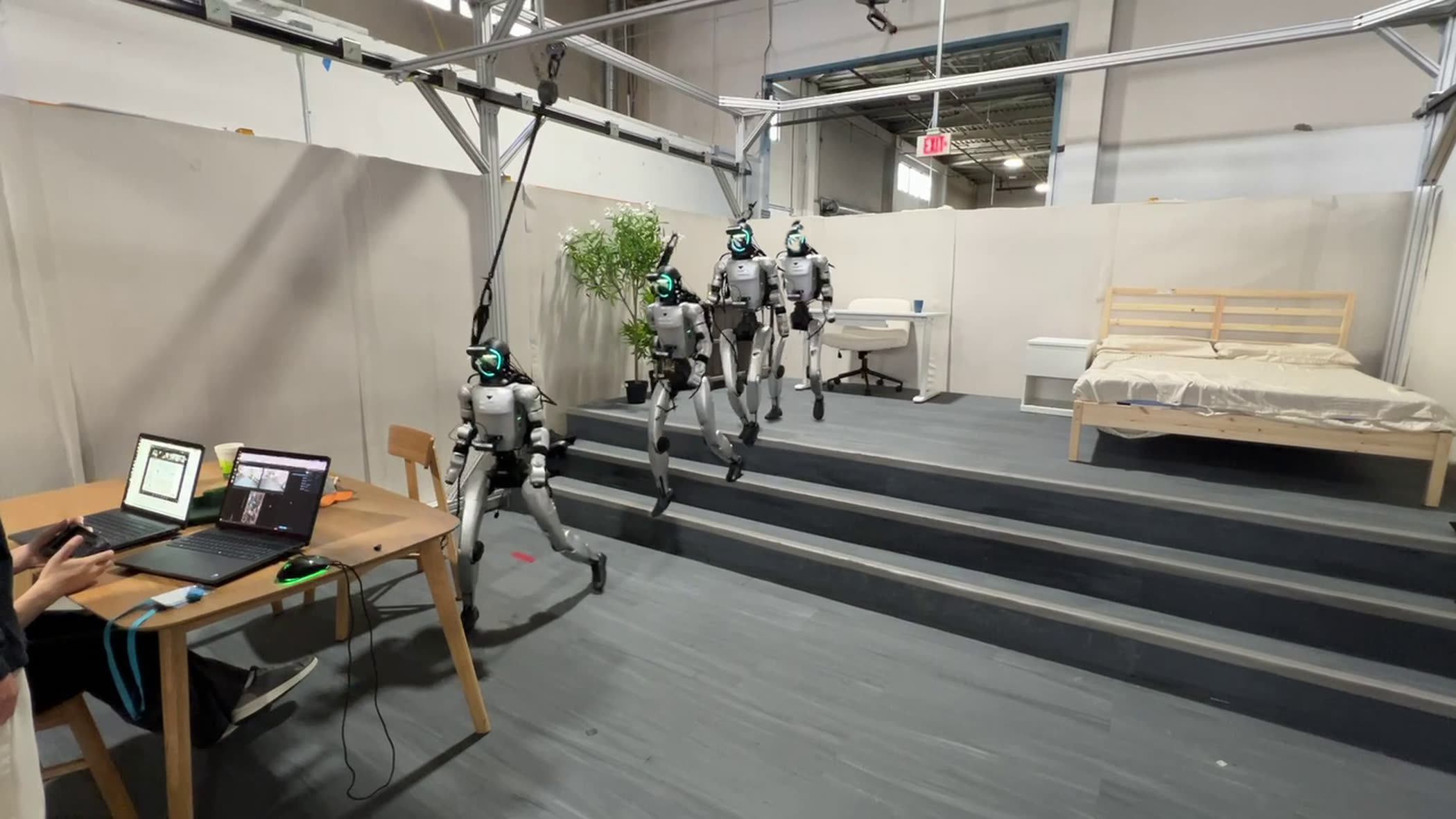
Recording · descending
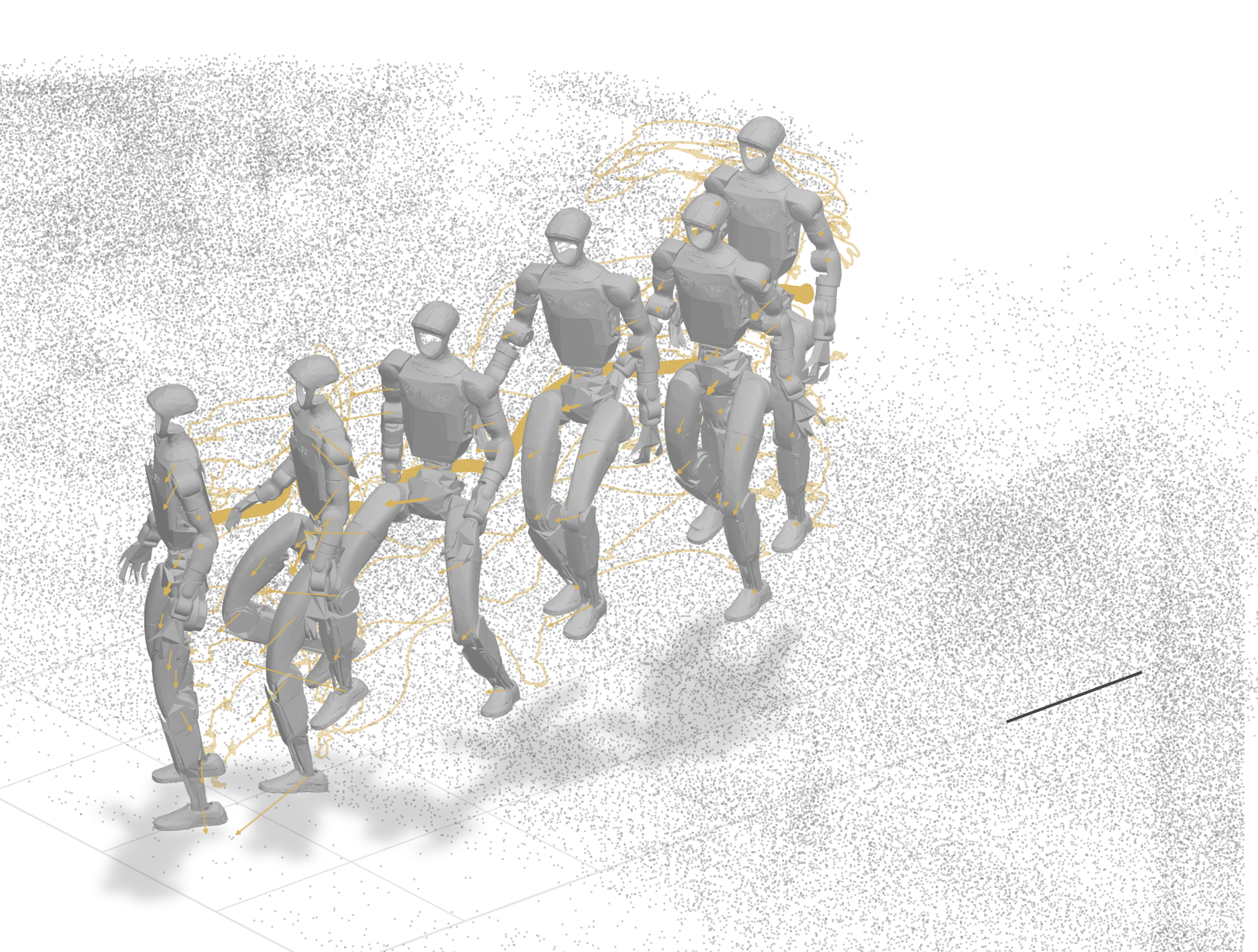
Ours
Inertial Odometry
One checkpoint, five datasets. AVE in m/s, ATE in m; ATEGT uses ground-truth attitude, ATEPred the gyro-integrated attitude. † trained separately per dataset, * sequences longer than 10 s only.
| Method | Human | Humanoid (G1) | |||||||||||||
|---|---|---|---|---|---|---|---|---|---|---|---|---|---|---|---|
| Nymeria | Natural Motion | BONES-Seed (Human) | BONES-Seed (G1) | Real-Trajectory (G1) | |||||||||||
| AVE | ATEGT | ATEPred | AVE | ATEGT | ATEPred | AVE | ATEGT | ATEPred | AVE | ATEGT | ATEPred | AVE | ATEGT | ATEPred | |
| Pelvis IMU only | |||||||||||||||
| TLIO† | 0.122 | 8.149 | 17.76 | 0.189 | 40.72 | 81.31 | 0.245 | 0.717 | 0.719 | 0.173 | 0.761 | 0.762 | 0.371 | 17.86 | 17.86 |
| AirIMU† | 12.62 | – | – | 109.3 | – | – | 0.212 | 9.472 | 505.5 | 0.281 | 11.83 | 306.6 | 6.231 | 731.1 | – |
| AirIO† | 0.069 | 7.481 | 113.9 | 0.280 | 158.1 | 157.9 | 0.140 | 0.530 | 1.918 | 0.118 | 0.720 | 1.690 | 0.350 | 16.82 | 20.48 |
| TartanIMU | 0.301 | 37.74 | 35.53 | 0.332 | 155.8 | 156.3 | 0.328* | 2.970* | 2.964* | 0.219* | 2.176* | 2.176* | 0.391 | 18.94 | 18.96 |
| Pelvis IMU + joint positions and velocities | |||||||||||||||
| AirIO w/ joints† | 0.060 | 6.912 | 39.64 | 0.080 | 14.11 | 209.2 | 0.205 | 0.907 | 1.652 | 0.123 | 0.620 | 1.565 | 0.190 | 5.976 | 22.25 |
| Shared 12-site multi-IMU input | |||||||||||||||
| Ours | 0.026 | 2.468 | 18.20 | 0.049 | 7.456 | 50.54 | 0.031 | 0.113 | 0.148 | 0.024 | 0.101 | 0.127 | 0.099 | 3.153 | 11.50 |
1 / 6Recordings shown in the paper
IMU–Language Retrieval
Recall@1 against 19 distractors and mean average precision, in %. The G1 categories withheld from retargeted-G1 training are recovered from human supervision.
| Method | Human | Humanoid (G1) | ||
|---|---|---|---|---|
| Nymeria R@1 / mAP (%) | BONES-Seed R@1 / mAP (%) | G1 · seen categories R@1 / mAP (%) | G1 · unseen categories R@1 / mAP (%) | |
| Collapse | 4.4 / 0.1 | 19.7 / 0.2 | 21.9 / 0.8 | 9.8 / 0.1 |
| ImageBind | 8.9 / 0.1 | 7.1 / 0.4 | 11.4 / 1.6 | 4.6 / 0.1 |
| IMU2CLIP† | 16.2 / 0.4 | 51.8 / 5.2 | 36.1 / 11.2 | 17.3 / 0.5 |
| Ours | 14.9 / 0.6 | 60.7 / 15.9 | 63.4 / 32.9 | 53.8 / 11.3 |
Learned Representation
t-SNE of human (blue) and humanoid (gold) window embeddings, either the language-head output or the trunk [CLS] feature; dashed regions enclose 60% of the windows of each labeled motion category. Rest the pointer on a point for a second (or tap it) to see the 4-s motion it encodes.
Loading embedding…
Compute scaling
Seven model sizes (2.8–274 M parameters), 235 EMA checkpoints. A Chinchilla-style fit gives and .
(a) Measured scaling
Loading scaling data…
(b) Fitted loss surface
Loading scaling data…
(a) Dots are EMA checkpoints; hover one for its run, measured error, and the law's prediction. Solid lines are seed-averaged measurements, dotted lines the fitted law at that model size, the dashed line the fitted compute-optimal frontier. (b) The fitted law over model size and tokens with the same checkpoints; hover anywhere for the predicted error (snapping to a nearby checkpoint shows its measured error too), drag to rotate. Dashed contours hold 6ND fixed; gold marks fitted minima and their path.